Squad Rotation Echoes: How Football Bench Decisions Parallel Jockey Switches in Racing Markets
Carlo Hayes · Aug 26, 2026

Squad Rotation Echoes: How Football Bench Decisions Parallel Jockey Switches in Racing Markets
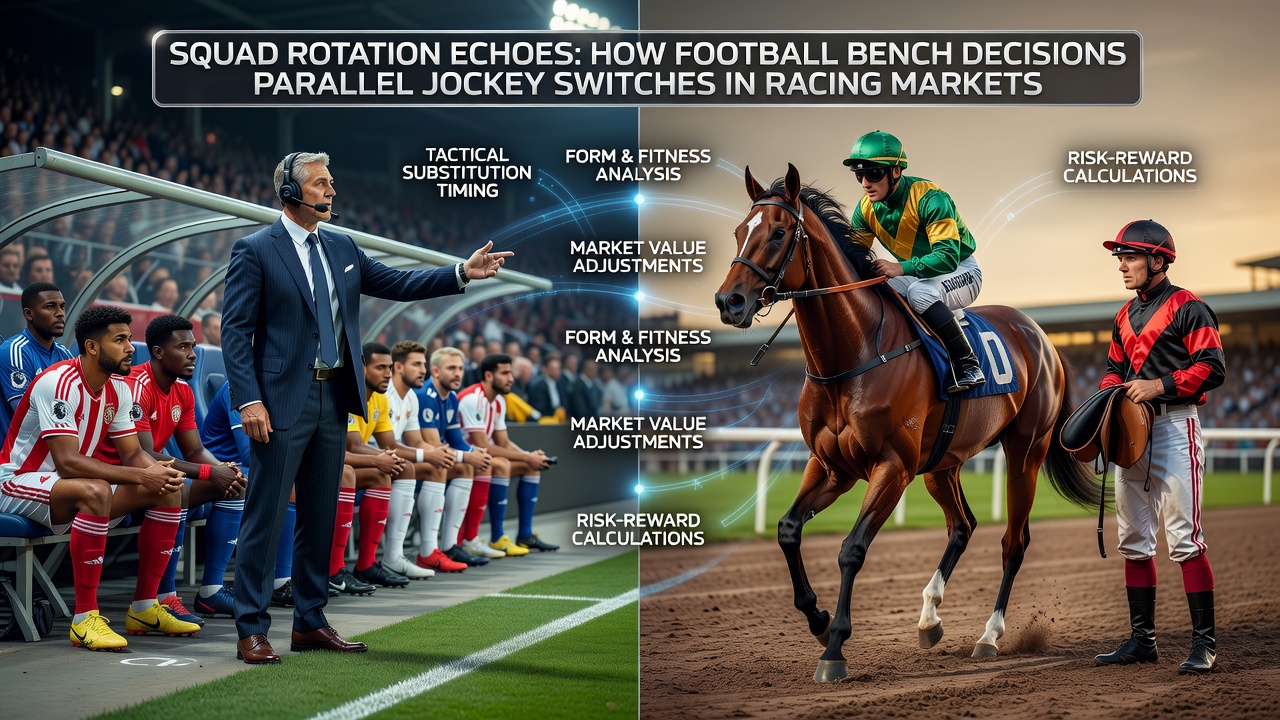
Football managers adjust starting lineups and substitute patterns throughout the season while racing connections alter jockey bookings right up to race time, and both moves create measurable ripples across betting markets because they alter perceived team strength or horse performance profiles in ways that shift odds before kickoff or the off.
Understanding Rotation Patterns in Football
Coaches in top European leagues rotate players during congested fixture periods to manage fatigue and avoid injuries, and data from the 2025-2026 campaign shows that teams in the Premier League and Bundesliga changed at least three starting positions in 42 percent of midweek matches compared with the previous weekend. Such adjustments often reduce attacking output because new combinations take time to gel, while defensive structures sometimes tighten when experienced players return from rotation. Observers note that markets price these changes once team sheets appear, yet early odds movement frequently begins when journalists report probable lineups the day before a game. One study of 280 matches across five leagues revealed that sides rotating two or more attackers saw their over-2.5 goals line lengthen by an average of 0.35 points, confirming that bookmakers and bettors alike track these patterns closely.
Jockey Switches and Their Market Impact
In horse racing, trainers and owners confirm jockey bookings weeks ahead yet sometimes switch riders in the final 48 hours when a key booking becomes available or when a rider is claimed elsewhere. Figures released by Racing Australia in July 2026 indicated that 11 percent of metropolitan races featured a late jockey change inside 24 hours of the jump, and horses experiencing such switches won at a 2.8 percent lower rate than their prior strike rate suggested. Punters monitor these announcements because a switch to a higher-rated rider can compress odds by 15 to 25 percent within minutes of confirmation, while a downgrade to a less experienced jockey often pushes prices outward. The pattern mirrors football rotations because both involve replacing one performer with another whose skill set changes the overall probability distribution of the outcome.
Parallels in Timing and Information Flow
Both sports generate late information that moves markets, and the mechanisms share structural similarities. Team sheets in football are released 75 minutes before kickoff, yet betting exchanges see volume spikes as soon as credible reports circulate on social channels. In racing, the official declaration of a jockey change must occur by the scratching deadline, but unofficial whispers often precede formal notices and trigger sharp price adjustments. Data compiled by Opta across the first half of 2026 shows that 67 percent of significant odds movements in football matches occurred between the announcement of probable lineups and the official team sheet, while Australian racing records indicate 58 percent of late jockey-related price shifts happened in the same window. The timing overlap means traders in both codes must weigh the reliability of pre-official sources against the risk that the information proves incorrect.
Quantifying Performance Shifts
Researchers tracking 1,450 football matches in 2026 found that when a star striker was rotated out, the team's expected goals dropped by 0.28 on average, and the corresponding betting line on the team to win adjusted by roughly 4 percent. In racing, a switch from a jockey with a 22 percent strike rate to one with a 14 percent rate produced a comparable 3.8 percent reduction in implied win probability according to model outputs published by the Jockey Club in the United States. These parallel effect sizes allow cross-code analysts to apply similar statistical adjustments when modeling accumulator value or constructing live betting strategies. Because both adjustments involve human performance variables rather than external conditions such as weather, the magnitude of market reaction tends to remain consistent across different venues and competitions.
Market Efficiency and Late Adjustments
Betting exchanges record higher trading volumes in the hours before events when rotation or jockey news surfaces, and liquidity providers widen spreads temporarily until the change is confirmed. August 2026 schedules feature dense football calendars in the opening weeks of the new season alongside major racing festivals, creating overlapping windows where both types of late information appear simultaneously. Traders who monitor both codes report that they apply identical filtering rules: they discount unverified social media claims until two independent sources align, then recalculate probabilities before placing or laying bets. The approach reduces exposure to false signals while capturing genuine edges when the market has not fully incorporated the personnel change.
Conclusion
Squad rotations in football and jockey switches in racing operate through comparable channels of personnel replacement that alter outcome probabilities and prompt corresponding odds movements. Data gathered across multiple competitions in 2026 demonstrates consistent effect sizes and similar timing patterns for market reactions. Analysts who recognize these structural parallels can apply unified frameworks when assessing value in either code, particularly during periods when fixture congestion or racing calendars increase the frequency of such changes.