Referee Tendency Analysis for Informed Live Decisions in Soccer Contests
Theo Günther · Jul 1, 2026
Referee Tendency Analysis for Informed Live Decisions in Soccer Contests
Referees shape soccer outcomes through decisions on fouls, cards, penalties, and added time, and analysts compile detailed records of these patterns across leagues to support live in-play choices. Data collection starts with match logs that track each official's history of yellow cards issued per game, red card frequency, and penalty awards, while observers note how these rates shift based on competition level and team styles. Studies from academic sources show that referees average between 3.5 and 5.5 yellow cards per match in top European divisions, yet individual officials deviate from this range by as much as 1.5 cards, creating measurable edges for those monitoring the trends.
Core Metrics Tracked in Referee Databases
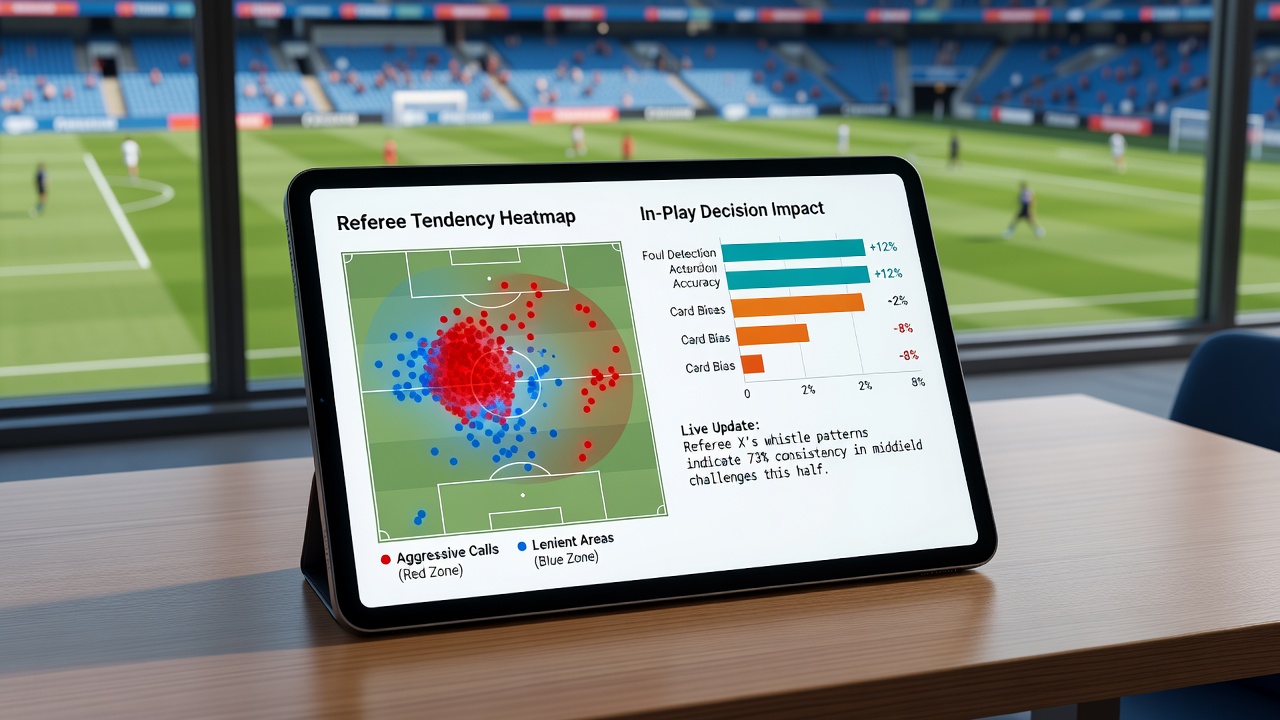
Analysts focus on several consistent indicators including cards per ninety minutes, strictness in the final twenty minutes of matches, and tolerance for physical challenges in midfield zones, while they also record how often a referee awards penalties in high-stakes fixtures versus routine league games. These figures come from centralized repositories maintained by competition organizers and independent data providers, and they update after every round of fixtures to reflect the latest performances. When a referee known for issuing early cautions steps onto the pitch, live bettors often adjust expectations for total card lines because historical samples indicate that same official reaches four or more bookings in over sixty percent of outings.
Integration with Live In-Play Platforms
Live betting interfaces update odds continuously as match events unfold, and systems that layer referee profiles onto real-time feeds allow quicker reactions when a card threshold appears likely to break. For instance, if an official with a high added-time average takes charge of a tied contest, markets on total goals or corners may move as the clock approaches ninety minutes because extra minutes increase scoring chances. Platforms pull from multiple seasons of data to generate probability adjustments, and these adjustments feed directly into the algorithms that recalculate odds after each whistle. Observers note that during July 2026 international windows, several confederation tournaments displayed elevated card counts under certain referees who had previously worked in domestic leagues with stricter physical-contact rules.

Regional Variations and Seasonal Shifts
Refereeing standards differ across continents, with South American officials historically averaging higher card totals than their Asian counterparts in club competitions, and these geographic patterns hold steady enough for analysts to build region-specific models. Temperature, pitch condition, and fixture congestion also influence decision rates, because studies indicate referees issue more cautions in matches played above thirty degrees Celsius or on surfaces that become slick after rainfall. During the 2025-2026 club season, data sets revealed a modest uptick in penalty awards in leagues that introduced video review expansions, yet the increase concentrated among a subset of referees already predisposed to review incidents more thoroughly. Bettors who cross-reference current match conditions with an official's past responses to similar environments gain an incremental information advantage before placing in-play wagers on cards or stoppage time.
Case Examples from Recent Competitions
One documented instance occurred in a 2026 Copa Libertadores group stage match where the appointed referee had awarded penalties in eight of his previous twelve continental assignments; within the first half the betting market for a spot-kick moved sharply after the first contentious challenge because participants recognized the pattern. Another example emerged in the English Championship where an official averaged 6.2 yellow cards across his prior twenty fixtures, and live over-card bets activated early once two bookings occurred before the thirtieth minute. These episodes illustrate how historical referee profiles translate into actionable signals once the opening phase of a contest establishes which tendencies are active on that day.
Combining Multiple Data Layers
Advanced approaches merge referee records with team disciplinary profiles and player-specific foul rates, producing composite probabilities that update after every substitution or tactical change. When a team missing its primary defensive midfielder faces a referee who punishes late challenges heavily, the combined likelihood of multiple cards rises, and this information appears in live dashboards used by professional syndicates. Software tools now ingest public match reports alongside proprietary tracking data, allowing continuous recalibration of expected card counts as the ninety minutes progress. The approach requires clean data pipelines and rapid processing, yet the resulting adjustments provide measurable improvements in forecast accuracy according to validation tests conducted by independent research groups.
Conclusion
Referee tendency analysis supplies a structured framework for interpreting live soccer events and adjusting in-play positions accordingly, drawing on accumulated statistics rather than isolated incidents. As competition calendars expand through 2026, the volume of available match data continues to grow, supporting more granular models that account for situational variables. Organizations that maintain transparent disciplinary records contribute to this ecosystem, and participants who integrate these layers with current match feeds operate from a clearer informational base when markets remain open.